Category Archives: Uncategorized

Movie Analysis, part III – Art

Movies3

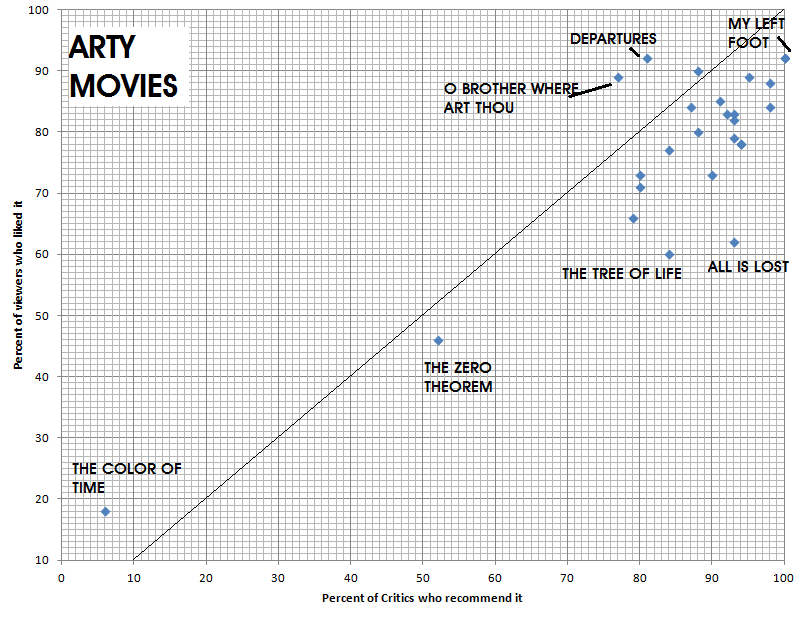
The next in my series of obvious conclusions is that movie critics like arty movies better than the general viewing public does. Take a look at the chart to confirm this if you feel a need. So what are “arty” movies? Again, very subjective on my part. Arty mostly refers to the art of movie-making, although I think there are a few movies where the subject matter of the movie is art or artists. I marked as arty any movie that seemed to use non-traditional (or formerly traditional but long out-of-favor) techniques (e.g. silent film, stop-motion, filming over 12 years or with 12 different directors), and movies that critics rather uniformly described as exceptionally artistically done. Since there aren’t too many, I’ll post the entire list at the end. Feel free to disagree with my label; it’s my blog so there’s nothing you can do about it. You can, however, contact me through the contact form on the “About the Author/Contact” link in the top menu. I’m obscure enough that I don’t hear much from readers, and I enjoy exchanging emails with those who do contact me. I allow comments on this blog.

I’ve marked a few outliers on the chart. For what it’s worth I liked Departures, My Left Foot, and All Is Lost. I didn’t like O Brother, Where Art Thou? I haven’t seen any of the other labeled ones. This will be the last movie analysis post for awhile, but I plan to keep adding movies and resume the analysis in future posts. There are still some surprises in store.

Here’s the list of “arty” movies:
My Left Foot
The Broken Circle Breakdown
The Commitments
Kon Tiki
The Tale of the Princess Kaguya
The Artist
Boyhood
Hugo
Force Majeure
All Is Lost
Birdman
Midnight in Paris
Nebraska
Coraline
The Spanish Prisoner
Life of Pi
The Tree of Life
Departures
Get On Up
Quartet
O Brother, Where Art Thou?
The Zero Theorem
My Winnipeg
Populaire
Song of the Sea
The Color of Time

Movie Analysis, part II – Politics

Movies2

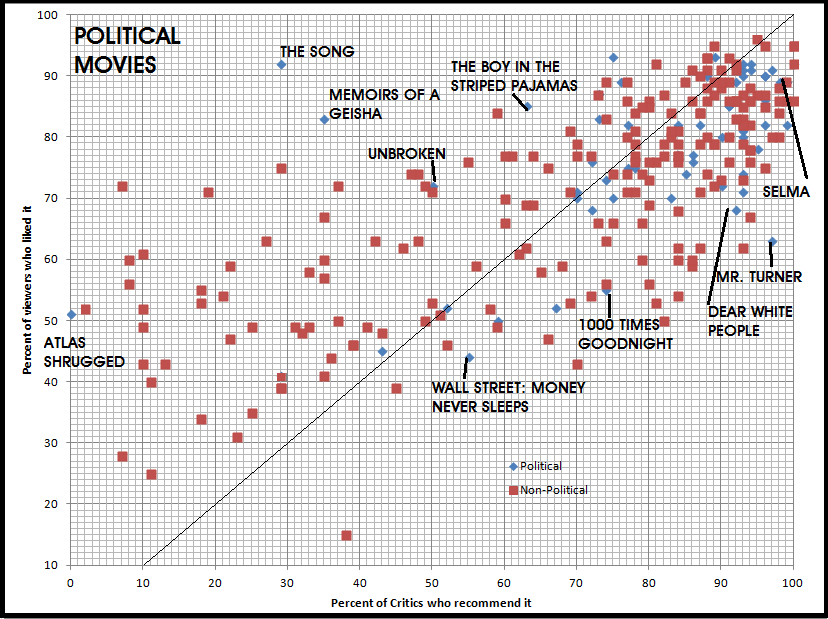
I’ll start with the conclusion here: movie critics are more liberal than the general population. Duh! This probably falls somewhere in the category of bears in the woods and the religion of the pope. Still, now you have data to prove it. The above chart shows political movies in blue and non-political ones in red. It’s not hard to see that a large majority of the blue diamonds are to the right of the diagonal line, meaning the critics ratings were higher than the viewers’ ratings. That could just mean that critics like political movies more than the general population does, and that’s probably true, too, but more significant is which movies fall on the right and left sides.

Before I go on, you may ask how I distinguished between political and non-political. It was a subjective judgment on my part, so feel free to discount the validity, but most were pretty obvious choices. Almost anything that had a strong theme related to traditional GOP-Dem type politics was included, but I also included anything heavily themed on social issues that are controversial or divisive, such as race relations, drugs, religion, women’s rights, and sexual orientation. Examples are Selma and Dallas Buyers Club. Less obvious are the ones I included because they were controversial or political within a particular community, even if not among the general public, such as Temple Grandin and Kon-Tiki. Most documentaries, fact-based (or “inspired”) movies, and biopics were included because they almost all dealt with controversial events or people. In case you’ve noticed some dots on this chart that weren’t there in yesterday’s, that’s because I used a larger percent of my database in order to include more political movies. Political movies in general had fewer viewers.

I’ve labeled most of the notable outliers, i.e. where the greatest differences are between viewers and critics. Since there are fewer of those on the left side, let’s examine those first. The Boy in the Striped Pajamas and Unbroken are both World War II movies where the Allies are the good guys and the Axis are the bad guys. It’s not difficult to see where these would be more appealing to conservatives than to liberals, but not by a great deal, which is why they rate fairly high with the critics, too. The Song is a faith-based story according to the description. You should be able to figure out which side of the political spectrum that falls on. As for Atlas Shrugged, if you are having trouble understanding why a total of zero critics liked it, go back to Poly Sci 1 or read the book. Perhaps less obvious to some is Memoirs of a Geisha. It’s not inherently political in its subject matter, although the notion of a geisha as an oppressed or exploited woman is not hard to put onto the political scales, but I think it likely offended critics for another type of politics: movie politics. The star was Chinese, not Japanese like the character, and the time frame depicted, spanning world War II, is one in which there was bitter hatred between those two nations. The director, screenwriter, and author of the book on which it is based are all white. I remember reading an article where the Hollywood elite allegedly thought this was an inherently Japanese story that should have been told and acted by Japanese, not their former enemies.

I’ll leave to you to look up the movies I’ve labeled on the other side of the line. I don’t think it will be difficult to reach agreement that they are more appealing to liberals than to conservatives. Lastly, we have to explain why the bulk of the blue diamonds falls to the right of the line, much more so than the bulk of movies in general. If movies, on average, are basically neutral, or equally biased on both sides, the dots should be more or less equal on both sides, if my premise about critics is true. That one is easy to explain. Movie makers and media people in general are more liberal than the general public. It is not the case that movies are evenly distributed over the political spectrum. A lot more “liberal” movies are made than “conservative” ones. Anyone who follows politics know that it is Democrats who go to Hollywood for campaign funds. Sure, we can point to Ronald Reagan and Clint Eastwood as conservatives, but they’re the exceptions that prove the rule.

Movie Analysis, part I

Movies1

I enjoy playing with data from time to time, and I enjoy movies, so I decided to compare how critics rate movies and how the viewers rate them. Take a look at the above chart. First, for you data hounds and methodology freaks, I’ll describe how I compiled it. All the ratings come from Rotten Tomatoes or Flixster, so neither the critics nor the viewers represent the universe of people in either category. Older (i.e. not so computer/social media savvy) people and foreigners, for example, may not be well represented. The movies to be included come from several sources: the ones I’ve rented or rated in Netflix since January 2011, including ones I streamed; nominees for Best Picture at the academy awards 2011 – 2014; all movies that made the top box office listing either in theaters or rentals according to Rotten Tomatoes for the last three months or so; several lists from major publications of the best all-time movies of several genres, e.g. thrillers. This last category is the only one that includes many older films. I may have rented an occasional older film, but the data is skewed toward newer releases. I acquired data on almost 300 movies but then sorted it to take only the 250 that had the most viewer ratings to eliminate some oddball losers, cult films, etc. I wanted movies with sufficient viewer input to be statistically significant. The cutoff number turned out to be 3400 viewer ratings. The number of viewer ratings correlates highly with box office numbers, but there could be some movies that get an inordinate number of ratings from very avid fans despite mediocre box office success, or limited success in the U.S. All used for this chart also had at least 20 critics’ ratings except for three, which had 8, 10, and 13 on that website.

As I understand it, the critics were given only two choices: to “recommend” a movie or not. Viewers could rate on a five-star system, and the website converts that to a single number representing the percentage of viewers who “liked” the movie. That means the percentage who rated it 3.5 stars or higher. These two rating systems are not exactly equivalent, but the percentages of critics who recommend and viewers who “like” a movie are close enough in general to make comparison useful.

The diagonal line in the chart represents equality in percentages between viewers and critics. Each little blue diamond is the rating for a particular movie (or possibly more than one in the case of identical ratings). So any diamond to the left of the line is a movie that viewers rated higher than the critics and those on the right, the critics liked better. The closer to the upper right corner, the more a movie was a favorite in both categories.

So what does this chart show? Not much yet, since I haven’t shown you many movie names or other data, but I threw in a few teasers so you can begin to get an idea of what it could show. I labeled the ratings for a few of the outliers, that is, movies where the viewers and critics differed the most. What characteristics do you think would be most common in those movies to the far left of the line, i.e. fan favorites that critics hated? How about the other way? I’ll give you one that applies to outliers on both sides of the line: low viewership. Generally speaking, those movies were “specialty” movies that were seen and reviewed by relatively few people. This was not always true, however. Memoirs of a Geisha, for example, was a mainstream movie, although not a box-office smash by any means.

Wait! you may say. There’s Temple Grandin up near the corner, quite close to the diagonal line, highly rated by critics and viewers alike, yet it barely made the cutoff in terms of number of viewer ratings. True enough, but there are two reasons for this: first, it’s an older movie (2010) that I happened to rent a couple of years ago, and Rotten Tomatoes wasn’t as widely used back when it came out, and second, it’s a biopic (e.g. biographical in nature) of someone who was not widely known. I’ve found that documentaries and biopics generally got significantly lower viewership numbers than pure fiction movies of all types. Of course there are exceptions. And what about Whiplash, a movie that’s gotten the highest viewer rating of all, and you’ve probably not even heard of it? It’s at the opposite end of the timeline. It’s brand new and I’ve found that when movies first come out, they are generally watched (and rated) by those who are big fans of that particular genre, star, or in some case, series. The viewer ratings are usually high at first, but I can guarantee you that by the time that one comes out on DVD it will be several, maybe many, viewer rating points lower. So don’t put too much credence in the validity of these ratings, especially for brand new releases.

So there are a few hints about what the data can show. In future posts I’ll explore some of the interesting correlations I’ve found. I think they’ll surprise you. As a reward for reading all the way to here, I give you a list of the most popular movies (over 100000 viewer ratings) that were rated the highest by viewers and by critics. You may consider putting them on your list.

  • Top Viewer ratings:
    1. Amélie
    2. Rear Window (1954 version)
    3. American Beauty
    4. Guardians of the Galaxy
    5. (tie) X-Men: Days of Future Past
    5. (tie)The King’s Speech
  • Top Critics’ ratings
    1. Rear Window (1954 version)
    2. Toy Story 3
    3. Gravity
    4. 12 Years a Slave
    5. True Grit (2010 version)

The Good Girl by Mary Kubica

The Good GirlThe Good Girl by Mary Kubica

My rating: 3 of 5 stars

The crime being investigated in this book is a kidnapping, a refreshing change from the usual serial murderer. Mia is the daughter of a wealthy judge; she’s kidnapped by Colin, a ne’er-do-well from the underclass. The story is told primarily by three voices – Mia’s mother, the detective investigating the case, and Colin. The scenes switch back and forth from “Before” and “After”. During the “After” scenes we learn that Mia is back home with her mother months later, but is suffering from a memory loss, so we don’t know what happened between those two nebulous time frames. Some people may find the changing voices and times disturbing or confusing, but I had no trouble following the storyline.

The author writes well and I found the characters credible. I’ve always liked seeing the same story told from multiple points of view, but that’s not exactly what happens here. The three characters are each telling different stories, i.e. what they did or what happened to them during the months. The ending has a twist to it that I didn’t anticipate, but I can’t say that contributed much. What makes the book interesting is the way the characters develop.

As a former FBI agent I know something about how kidnappings are investigated, although this begins as a missing person case, not a kidnapping. I found the police procedure part to be relatively believable and well-done, better than most such books by non-law enforcement writers.

View all my reviews

Redwood City in February – 68 degrees

I was geocaching with a friend recently and had my DJI Phantom with me so I took some random video and aerial stills. It was a cold (about 68 degrees F. at 11:00 AM) February day in Redwood City. Ha ha ha. Eat your heart out, Boston! And people wonder why anyone would live in California with our astronomical real estate prices.

Music credit: “Two Finger Johnny” Kevin MacLeod (incompetech.com) Licensed under Creative Commons: By Attribution 3.0

Scott Adams’s favorite tweets

Scott Adams, author of the Dilbert cartoons and a popular blog, recently shared a list of his tweets that were the most popular. Here’s a partial list:

I wish I were dumber so I could be more certain about my opinions. It looks fun. (41)

I would hate to live in a world that rewards ignorance. What? Uh-oh. (with photo of graph of book sales)(26)

Outragists are the new awful: (link to my blog article) (29)

While no one was paying attention, weather reports became accurate and the news became fiction. Did not see that coming. (26)

I knew a guy with passion to be a pro golfer and the brain to be a great accountant. He followed his passion. He’s homeless now. (25)

If you can’t construct a coherent argument for the other side, you probably don’t understand your own opinion. (23)

Outragism: The act of generating outrage by quoting famous people out of context. #outragism (23)

Dear calendar makers: Put the weekEND at the END of the row. Sunday is not the start of the week.(with photo of revised calendar layout)  #Google #Apple (20)

Guys: If you ask a woman on a date and she says “possibly,” act optimistic and immediately make other plans. #datingadvice (16)

Salesman: These mattresses are hand-made! Me: Can you show me the good ones made by robots? #robots (16)

World’s shortest IQ test: “What percentage of your reality do you understand?” Grading: The higher the percentage the lower the IQ. (18)

My blog post about science’s biggest failure is melting the http://Dilbert.com servers with traffic. Hits a nerve. (Link to article) (18)

Best skill combination ever: web graphic design and web analytics. Learn those things and own the world. (16)

Fancy hotel has personalized products in bath. Not the first time I have seen my name and “douche” on same page. (photo of gel douche) (14)

My most popular tweets are the ones that insult dumb people. Everyone is confident I am talking about other people who have it coming. (12)

Here’s the link to his blog: http://blog.dilbert.com/post/110543090261/twitter-is-my-laboratory

Maybe you should be following him instead of me. Or both of us.

Still Life by Louise Penny

Still Life (Chief Inspector Armand Gamache, #1)Still Life by Louise Penny
My rating: 3 of 5 stars

Still Life is the first Inspector Gamache mystery, a very popular series among mystery readers. This series is set in Quebec but is written in English, although French expressions are used occasionally and the malaise that separates the francophones from the anglophones is depicted at times.

The strength of this book is the detailed descriptions of Quebec village life and its people, a geographic and sociological location with which most English-language mystery readers have little familiarity. The characters are fully developed and very diverse. The main character, Gamache, is likeable.

The plot line is very much like Agatha Christie’s novels. It fits in the Clue game genre, that is, the possible suspects are limited to a small set of people, in this case the inhabitants of the tiny village of Three Pines. You know from early on that it is one of the characters you are reading about, and the author populates this set with enough characters and motive to keep you guessing.

The milieu (see, I took French in high school, too) kept me interested enough to finish the book, and I can honestly say I enjoyed it, but the dénouement left me unsatisfied. The murderer is revealed, of course, but I found the resolution to be all-too-random. It could just as easily have been someone else. It was almost as if the author got to the end and decided it was time to solve the mystery, then drew a name out of a hat and devised an explanation for why and how it was done. A good mystery either contains enough clues to let the astute reader figure out the ending and solve it, or a surprise ending that delights you in its unexpectedness. This did neither. I was perhaps a bit put off a bit by the way Gamache treated his new associate Nichol. She was actually quite realistic and more likely to solve a real case with her approach than Gamache would.

So if you’re a fan of ambiance and interesting characters and locales, try a Gamache book. If you prefer a plot-driven mystery with plenty of sleuthing, this may not be the best choice for you.

View all my reviews

Held for Ransom – free

Held for Ransom (Kindle edition) will be free this Friday and Saturday. Spread the word. If you’ve only read the geocaching-themed books, this is your chance to see how Cliff got started, before geocaching existed, to learn about his strengths and frailties, his insecurity. It’s also a very realistic view of what a real kidnapping case is like. You could learn something that could save your life in the unlikely event you became the victim of one.

50-year high school reunion coming up

I graduated from high school fifty years ago this June. We’re having a reunion later in the year. I started to write our 50th reunion, but it isn’t, since we’ve only had a few reunions. So I’m calling it our 50-year reunion. I am a word fanatic, after all. Below is a photo of me along with several of my classmates. I’ll let you guess who is who.

ALHS1964

Superbowl Snobbery

I’m not a big pro sports fan, but I enjoy a good football game, and yesterday’s Superbowl certainly met that description. I noticed something during the game that I’ve seen before while watching pro football. The announcers mentioned during the game that Richard Sherman of the Seahawks went to Stanford. They also mentioned that another player, one whose name I’ve forgotten (there are others on both teams), had also gone to Stanford. Yet at no time did they mention that either Marshawn Lynch or Shane Vereen, the two star running backs for the opposing teams, had gone to the University of California, Berkeley (Cal). Both played much more of a role in the game than Sherman or the other Stanford player.

The comments were elitist at best, and possibly even racist. The implication was that these players weren’t just dumb jocks as you might expect because, hey, they went to Stanford. There may even have been an unintentional hint that it was surprising because they were black “speed” players in “non-cerebral” positions, i.e. anywhere besides quarterback, I suppose. However, this racist tinge may not have been behind it, since Lynch and Vereen are black, too. I think the announcers or copy writers simply had a perception that an athlete has to be unusually smart to go to Stanford, which makes the mention of their school noteworthy, whereas the others went to Cal, which is “only” a public university, and we all know any dumb jock can get into Cal, right?

Wrong! Wrong on both counts. As anyone who has ever followed college football knows, the top football schools, public or private, let in a ton (literally) of players on athletic scholarships who are nowhere near capable of entering the school on their grades or test scores. Plenty of semi-literate morons have gone to “elite” private schools to play football. O.J. Simpson is a notable example at USC, and don’t get me started on Notre Dame. On the other hand, all the top athletic schools have examples of highly intelligent athletes, of all races. I am reminded of Kareem Abdul Jabbar, a UCLA graduate and probably the best basketball player of all time, who spoke at my son’s graduation. Jabbar was by far the best graduation speaker I’ve ever heard – articulate, witty, poised, with perfect grammar and a large vocabulary. For those acronym-challenged, UCLA is part of the public University of California system, like Cal.

True, Stanford has a lower admission rate than Cal now, making it harder to get into. In fact, it’s harder to get into than any university in the country, including the Ivy League, but that doesn’t make it tops academically. Cal still has more Nobel Laureates than Stanford and is extremely selective in admissions with only a 17% admission rate, and that’s with a statutory requirement that the university system must accept the top 10% of each high school’s graduates if they apply. In other words, if your child graduates in the top 10% of his or her California high school class, the university must admit him or her (although not necessarily the campus of first choice). So, announcers, how about some equal time for Cal if you’re going to mention schools.

I’ve never met Sherman, Lynch, or Vereen or even heard them interviewed. I don’t know how smart, dumb, or educated they are and it doesn’t matter to me. They’re all great football players who made for good entertainment from time to time. They do their jobs just fine. The television announcers? Well, I’m not so impressed with their intelligence. Thank God for the mute button.

Murder by the Book by Rex Stout

Murder by the Book (Nero Wolfe, #19)Murder by the Book by Rex Stout
My rating: 4 of 5 stars

No one can legitimately call himself a fan of murder mysteries without being familiar with Nero Wolfe. The Wolfe books harken back to the days of the potboilers when detectives were dicks, the gorgeous women were dames with good front sections, and there was none of this folderol about character development and conflicted emotions or troubled personal relationships. The plots, and to some extent Wolfe himself, are Sherlockian. Wolfe, brusque, iconoclastic, and famous for his deductive powers, sits his seventh of a ton in his New York penthouse and waits for cases to come to him. And come they do, in this case, with a client coming to hire him to solve the murder of his daughter. More murders ensue.

The Wolfe stories are narrated by Archie Goodwin, the Dr. Watson equivalent, who is Wolfe’s right-hand man. Archie is a smart-alecky young fellow, quick with his wit, his fists, and the ladies. Almost all of the action in the story is really Archie’s, with Wolfe making only rare appearances to exhort Archie to “bring me something” and on rare occasions, to dole out a begrudging “satisfactory.” The rest of the time Wolfe can be found in his plant rooms tending to his orchids or dining on one of the delicacies prepared by his chef, Fritz.

Wolfe’s relationship with the police is prickly at best, very much like that of Holmes with Scotland Yard. Cliché it may be, but the mystery is not fully resolved until Wolfe calls all parties to his penthouse for the big reveal, which, of course, only he has deduced.

I’ve read a couple of Nero Wolfe books in the past, probably more than a decade ago, and their formulaic nature deters me from reading them with any frequency, but it’s a good formula and I thoroughly enjoyed this one.

View all my reviews

Rant of the Week – Verizon

Today I was geocaching on top of Black Mountain off Montebello Road in Cupertino, the exact same spot mentioned in my book Cached Out. The views were gorgeous, both looking toward Silicon Valley and looking south toward Santa Cruz. There was a heavy fog layer both directions, but we were up above the fog and the sun glistened off the snowy billows, with mountain tops peeking through. Okay, pun intended there. Although I don’t carry a smart phone and get sick of looking at most people’s photos of their trips, whether geocaching or not, the view was so pretty today, I decided the exceptional nature warranted some photos. I pulled out my old Verizon (LG) flip phone and snapped three shots.

I used to be able to upload photos from my phone to a Verizon site called PixPlace. I’ve done it several times in the past, but not recently. I tried to send them from my phone to that site the usual way, by selecting PixPlace from the phone menu, but the connection failed. So I got home and tried to log on. It turns out I couldn’t log on because PixPlace was discontinued last fall. I was redirected to another Verizon site. It required the userid and my old one no longer worked. I was perplexed. It then asked me to verify I was the account holder by entering the last four digits of my social security number. I did. It failed. I then realized that my daughter is the official owner of the account now. She had some discount from her employer a couple of years ago and thought she could get a better rate so we let her take it over. She got the better rate but it turned out to be a false savings  because now the usage from my wife and me is on her account and she is reluctant to ask for us to pay her for it. We give her orders of magnitude more money at Christmas than the cost of our phone bill, which is modest, so she doesn’t think it’s right to ask and we don’t really want to be bothered writing her checks every month. However, I knew that when we made the switch it took about an hour of futzing around with Verizon to make sure I was still a “manager” on the account so I could deal with my wife’s and my account problems. Still, the website just sat there demanding the four digits. I looked around and realized I didn’t have them. We used to use them all the time for tax returns but she hasn’t been a dependent for years, so I didn’t know where to find them.  Id been redirected to something called Verizon Cloud. I couldn’t log on there either, for the same reason, but it looked to me like I would be able to upload my photos there and then download them once I got logged on once I created yet one more account.

Just as I was stymied and contemplating my next move, a chat window opened up from customer support asking if she? (Terri) could help me. I explained the situation. She said to connect my phone to my computer with a USB cable. I told her my phone didn’t have one. Then she said the charging cable would have one. I contradicted her. Then she told me to buy an adapter and a memory card to transfer the photos off my phone to my computer. I told her I didn’t want to buy a bunch of equipment just to get three pictures from my phone. I asked if she could just transfer my PixPlace account to the new Verizon Cloud. She said no, the flip phones aren’t compatible with the Cloud technology. I would need to buy a smart phone and a new data plan. Rip off! After fifteen minutes of this sort of thing she then said I would need to talk to Tech Support and gave me a 1-800 number.

I called that number, went through an interminable phone tree and finally got to a selection that said to push three for Tech Support. I pushed three. Then they asked for the 4-digit social security number associated with the account. Grr! When I didn’t push any buttons a woman finally came on the phone. I explained the whole thing again. She was very polite, but basically if you reread the last paragraph, it went almost exactly the same way. Yes, that included at the end when she said I needed Tech Support. I said I thought I was talking to Tech Support. She said no, she was with customer support. So I got transferred once again.

Person three was a very cheerful young woman who was obviously more knowledgeable than the first two. For the third time I went through the whole story and recommendations outlined above. The one thing different she did was insist that I go and unplug my charger and look at the end. She was so sure there was a USB port there, but of course there wasn’t. She found this so incredible that she put me on hold and after five minutes of me waiting she found that I got the phone in 2007 and the USB ports on chargers didn’t come into being until 2008. So then she looked up available charging cords for my unit and another five minutes later determined that there is no compatible USB-enabled charging cord for my phone. She then put me on hold yet again and went to talk to someone more senior (age 25+ maybe?) who actually was alive and using phones in 2007 and might know something about steam engines, abaci, and LG flip phones. Another five minutes gone. After I dismissed all the suggestions of buying a smart phone and data plan, I heard her mention something about texting. This was lost on me at first because it had never occurred to me that it could be possible to text a photo. The whole reason texting was invented is to take advantage of the extremely small bandwidth text messages use,  which could be crammed into unused cell phone frequency space at essentially no cost, and yet the phone companies could charge extra for it. And, boy, have they! I have texting blocked on my phone and know little about it. Anyway, I asked if it was possible to send a photo via text. If so, I could just text it to my daughter or anyone else and they could email it to me. Without calling me a moron she said yes that was possible. Great, I said, only I have texting blocked. Can I unblock it so I can send these photos, then get it blocked again? Yes, she said delightedly! Finally the problem is solved.

So you can guess the next step, right. I asked her to unblock it for me and she started to do it. The only problem was, she couldn’t “verify” the account, even though I was calling on my own phone and knew the names, addresses, and numbers of everyone on the account. She said she was locked out of the administrator access without getting the four-digit password, which was, of course, the last four digits of my daughter’s social security number. Curses, foiled again! I pointed out that I was a manager on the account, which she confirmed, but said it didn’t matter, she was facing a screen that required the password and had no way to get by it without the number. She asked if my daughter was home and I told her I didn’t know, but to give her a call. Another six or seven minutes go by and she comes back on the line and says she tried twice and couldn’t reach my daughter, but she had another great idea. I could drive to the nearest Verizon store and show my photo ID and they could verify the account with that and give access to unblock texting. Great, after a six-mile very steep hike with me now nearly falling asleep at my computer I’m supposed to get in the car and wait in line t a store to get three photos off my phone, and then repeat the process afterward at some point. I said no and gave up, defeated by Verizon’s calculated strategy, first invented by Apple, to make everything incompatible with whatever technology they used two years earlier so that customers are forced to buy, buy, buy every two years and upgrade in between every month or so.

I hung up. The whole process had taken around 45 minutes, maybe longer. An hour later I remembered where I stored a document that would have my daughter’s social security number on it. I dug it out and there it was! One minute after that my daughter called me and asked why Verizon had called her about giving me access. She said we had taken an hour when the account was transferred to her to make sure I was a manager and could do everything on my own account without involving her. I gave her the short version and she was flabbergasted at how difficult it had been, but she offered to call Verizon and cancel my text blocking for me. I said no, I can now do it myself. The more I thought about it, I decided not to bother. The camera on the phone is so bad I’m sure the pictures would be a disappointment. There’s maybe 100 pixels in those things. The pictures look like a landscape made out of Legos. As my wife said, I’ll still have my memories. It really was the most gorgeous view I’ve ever seen geocaching, with the possible exception of one view from a park in the Queen Anne section of Seattle overlooking the sound, the city, and the mountains on a crystal clear day. And as I said, I know that despite what people say, they really don’t want to look at other people’s photos, they want other people to look at their photos. That’s true for me at least. I won’t inflict these on you. If you want to see that view go hike up Black Mountain like I did. A photo can never do it justice. So maybe in the long run it was all for the best, but for Pete’s sake, Verizon, at least when you say you’re transferring me to Tech Support, please transfer me to Tech Support, although I probably won’t be your customer much longer. And make the PixPlace data compatible with Verizon Cloud. It’s just bits and bytes. That’s what programmers are for.

The Storied Life of A.J. Fikry by Gabrielle Zevin

The Storied Life of A.J. FikryThe Storied Life of A.J. Fikry by Gabrielle Zevin
My rating: 4 of 5 stars

Our eponymous hero is an arrogant, unkind, elitist bookstore owner on Alice Island off the Massachusetts coast, dependent on summer tourists who are increasingly turning to ereaders. Recently widowed and in a bad place emotionally, he excoriates the klutzy new sales rep from Knightly Press who comes to present her company’s winter reading list. Bah, humbug! Soon a mysterious theft occurs – a rare and very valuable first edition is stolen from his store, something he had found serendipitously at an estate sale. He had been counting on that for his retirement nest egg. Now he was going to have to be nice to people because the store was barely scraping by and retirement was not in the cards.

Soon thereafter he comes back to his store after an errand and finds a young child and a note left there. The mother, who is soon discovered to have committed suicide after abandoning the child, wanted the precocious child to grow up around books, hence the choice of A.J.’s store. He must turn the child over to Child Protective Services, of course … but then surprise, surprise, the near-perfect child begins to melt the icicles in his heart à la Ebenezer Scrooge. The rest of the story arc is pretty predictable but that doesn’t diminish the enjoyment. The missing first edition mystery keeps a little suspense going, but as you learn more about the island’s inhabitants, mystery fans can pride themselves in figuring that one out, too.

I chose this book because of its long-time appearance on the best-seller lists, so I have no illusions about bringing a hidden gem to your attention, but since most of my readers are mystery fans, this one might not have been on your radar. Four stars is a bit strong, perhaps, but I enjoyed the book. The characters are (eventually) pretty much all likeable and the quaint setting fun as well.

View all my reviews