Category Archives: Uncategorized

The Reader by Bernhard Schlink

The Reader The Reader by Bernhard Schlink
My rating: 3 of 5 stars

This translation of a German novel about post-wartime Germany is engaging but ultimately left me with a feeling that it could have done more. Michael, a teenager, falls for an older woman in his neighborhood and she proceeds to satisfy his lust, playfully at first as though he is her boy toy. It develops into a real relationship of sorts, although Michael is not sure if she feels about him the way he does for her. When it stretches beyond a mere sexual relationship, they spend a weekend together. She likes his voice and asks him to read to her. He obliges. This continues for some time. Then one day she ends it cold. It turns out she has a secret. I’ll stop there to avoid spoilers.

I listened to the audiobook, which was well acted by the narrator. The translation is excellent, too. As I listened, I didn’t know it was a translated German novel, although I suspected it. The book is somewhat dark, but not overly so. I think it resonates better with Germans than it could with most Americans, including me. In the end, I felt lukewarm about it. There was a movie made of it, but I never saw the film.

View all my reviews

One Across, Two Down by Ruth Rendell

One Across, Two DownOne Across, Two Down by Ruth Rendell
My rating: 3 of 5 stars

This book is something of a time capsule. It was written in the 1970s but might as well have been in the 1930s. Modern day Americans will have a hard time believing that people in the U.K. in the 1970s lived the way Stanley and Vera did, with no car and no refrigerator. Stanley is a lazy, greedy lout who married Vera for her family money, only to find that his mother-in-law controlled it all and planned to leave it all to Vera. She lives with them in their dumpy house but is trying to convince Vera to leave Stanley and come stay with her in a nicer place she will pay for. Vera supports them with a menial job while Stanley goes from temporary job to temporary job of an even more menial nature, like gas pump attendant. Make that petrol pump. The story is told from Stanley’s point of view as he cogitates how to bump off the old bat before she lures Vera away and leaves him penniless. Then fortune provides him with an opportunity. I will leave it there to avoid spoilers.

The book is unsophisticated in several senses – the plot line, the writing style, the lifestyle of the characters. This is not necessarily a bad thing, but it does tend be rather heavy-handed. The title refers to Stanley’s penchant for crossword puzzles, but that aspect really has little to do with the plot. I suspect it was chosen solely so the author could insert some clever British-style cryptic crossword clues she had on hand for general amusement. There’s no gore, sex, or sadism, so it wouldn’t sell in today’s market but that aspect is at least a refreshing change for some of us.

View all my reviews

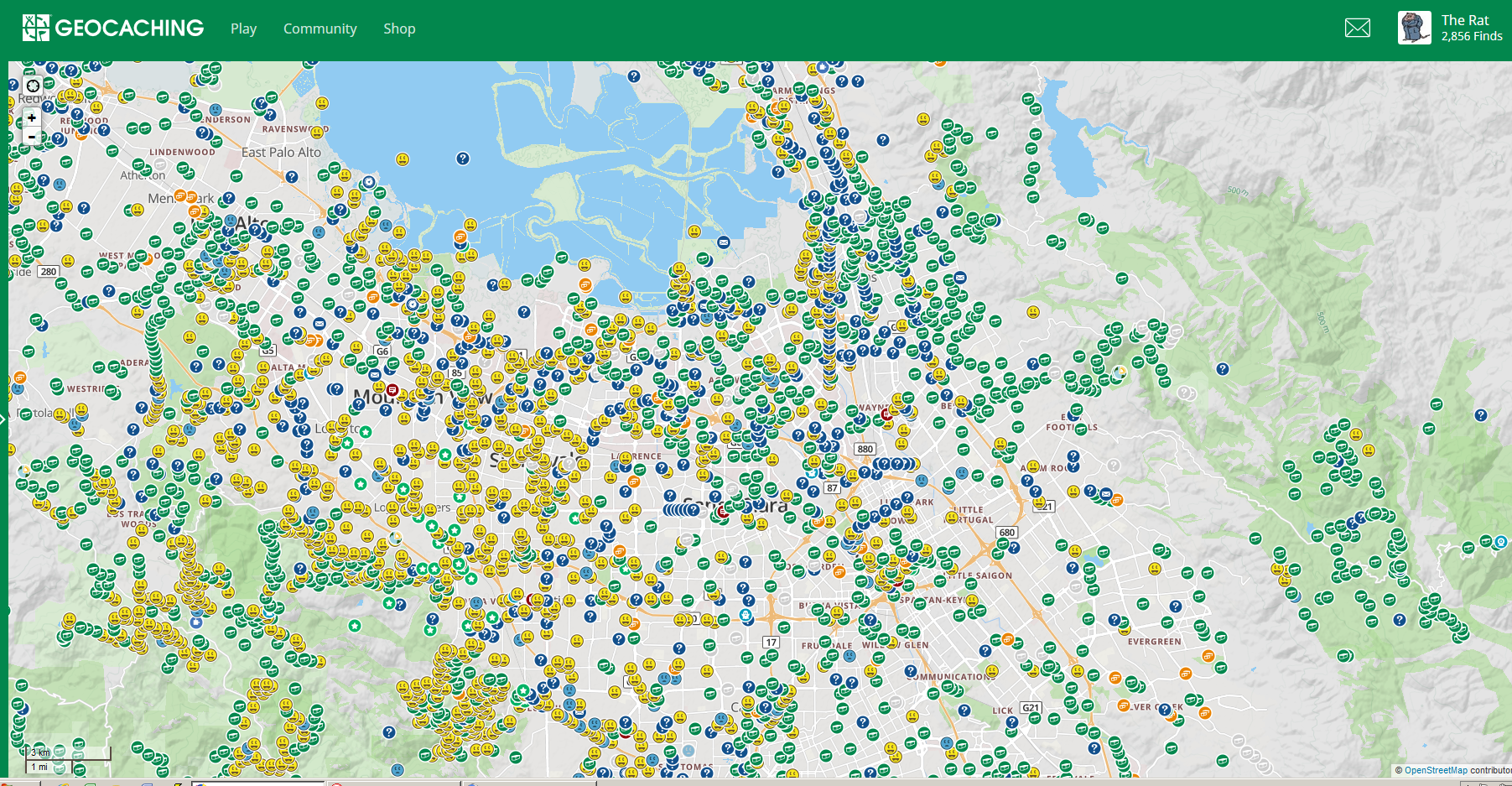
Geocaching map – South Bay (Silicon Valley)

South Bay Area

Above is a geocaching map of my local area. For my geocaching friends, this is old hat and doesn’t need explaining, but for those not so addicted and with nothing better to do, I’ll provide a bit of context. Click on the map to enlarge it if you want to understand it better.

This is a map of most of the southern section of the San Francisco Bay Area, the heart of what is now known as Silicon Valley. The big blue part is the southern end of San Francisco Bay itself. The area shown is approximately 20 miles across by 10 miles from top to bottom. Geocachers from other parts of the world may be surprised at the cache density. All the icons represent caches that are still active, i.e. can currently be found. It does not include ones I have found or hidden in the past if they are now archived. The yellow smilies represent caches I have found. The blue ones with the frownie face are ones I looked for but Did Not Find (DNF). The green ones with stars in them are caches I hid. The green ones with the box-like thing in them are regular caches I haven’t found. The blue, orange, and any other colors are caches of other types that I have not found.

A good forensic analyst, one who figures out where serial killers or arsonists live or work, could probably identify where I live from this. If you’re a fan of my Cliff Knowles Mysteries, but don’t know much about geocaching, this map may give you a better idea of the nature and popularity of the sport.

Rocket Men by Robert Kurson

Rocket Men: The Daring Odyssey of Apollo 8 and the Astronauts Who Made Man's First Journey to the MoonRocket Men: The Daring Odyssey of Apollo 8 and the Astronauts Who Made Man’s First Journey to the Moon by Robert Kurson
My rating: 4 of 5 stars

This thorough recounting of the first manned trip to the moon is riveting in parts and educational throughout. The complexity and enormity of the undertaking are only appreciated after reading this book. The mission was an extremely daring choice by NASA since the Atlas rocket was not a proven vehicle and the training schedule had to be greatly rushed. The biographies of the three astronauts are set forth with the right amount of detail, enough for us to get to know them and their families as people but with the focus kept on the voyage to the moon. The author tends to be quite repetitive, thus causing me to drop a star on the rating. How many times to we need to be told that if step X goes wrong the astronauts could end up crashing into the moon, flying off into space or trapped in a lunar orbit indefinitely? He does it about three or four times every chapter. Still, it was an enjoyable read.

View all my reviews

Educated by Tara Westover

Educated: A MemoirEducated: A Memoir by Tara Westover
My rating: 5 of 5 stars

The author, a young woman brought up in a violent, fundamentalist, survivalist family in mountain Idaho, writes of her escape from that life and joining the modern world where she ended up earning a Ph.D. from Cambridge. As unlikely as that may seem, it pales besides the absolutely incredible (yet believable despite this) story of the abuse, fanaticism, and rationalization that her family experienced. It is difficult to read at times. It is much like the cliche of watching a train wreck in slow motion. At least in this case you know from the book’s very existence that she has survived the ordeal. She was “home schooled,” which in her case seems to have consisted primarily of learning domestic skills, obedience, and religious doctrine of a most bizarre nature. She never attended a real school, yet was able to enter BYU at age 17. Her ignorance of the outside world was so extreme as to be amusing at times, embarrassing at others, and not understood by her peers and professors.

The story is also difficult to read without drawing parallels to today’s national politics, but I’ll leave it at that. The writing is beautiful, but about very unbeautiful things. I’ve noticed that most of the negative or lukewarm reviews are by people who simply don’t believe some of the greatest excesses the author describes or the fact that she couldn’t see how abusive and destructive her family was and why she didn’t just stay out and not look back once she left. I’ve heard reports from enough cult members and kidnap victims to find it very believable, if not totally understandable. It is a very hard thing to reject everything your parents have taught you at least when you’re a teenager even when you are rebellious. Think about all the things your own parents did wrong or believed that you only came to realize when you were an adult, maybe not even until middle age, and how you probably still clung to family loyalty even if it wasn’t 100%. The book was so compelling I raced through it. You may not necessarily like it, but it is an education.

View all my reviews

Midnight at the Bright Ideas Bookstore by Matthew Sullivan

Midnight at the Bright Ideas BookstoreMidnight at the Bright Ideas Bookstore by Matthew J. Sullivan
My rating: 4 of 5 stars

Lydia works in a bookstore and is in a happy relationship with her boyfriend David. But she harbors a secret, a violent one, from her past. The funky local bookstore is home to a collection of characters she calls the BookFrogs. One day, one of her favorite BookFrogs, a troubled young man named Joey, hangs himself in the store. This tragic act opens up a cascade of events reopening her troubled past and changing the fate of several of the characters in the book.

The story is slow to get going, but it eventually unfolds into something like a traditional mystery. The characters, including Lydia, are not entirely likeable for various reasons. One bugaboo I have is that many of them smoke, which to this author is apparently still a cool thing to do and makes people attractive. (NOT!) This fallacy is still prevalent in movies and TV, I’m afraid, but I digress. The pace of the book is good once the plot gets into full swing about halfway through. The story is told in two temporal stages, switching from the present day to Lydia’s childhood, another irritating but currently popular stylistic choice. The clues to the mystery are doled out sparingly but fairly so that the astute reader can begin to see a glimmer of the solution before it arrives, but the full resolution isn’t revealed until the end. There were a few loose ends that were never explained, like Joey’s unusual manner of “writing” to Lydia before his death. The ending, especially the epilogue, was not entirely satisfying to me, but it avoided cliches and sappiness that might have been worse.

View all my reviews

The Undoing Project by Michael Lewis

The Undoing Project: A Friendship That Changed Our MindsThe Undoing Project: A Friendship That Changed Our Minds by Michael Lewis
My rating: 2 of 5 stars

I read this book all the way through and I’m still not sure what the point of it is. The main theme seems to be that statistics and analysis are better predictors of performance than people’s gut instinct or commonly held stereotypes. Sure, I’ll buy that, and expected as much since this is the same author as Moneyball. But that point is made in the first chapter. Then the author goes off into a long section on the Houston Rockets and their recruiting strategy. Then he jumps to a biography of an Israeli psychologist who is the smartest person in the university, including every discipline, even Physics. Then he does the same with another Israeli psychologist who is also the smartest person anyone has ever met. Then yet another. Funny, I’ve never heard of any of these reputed geniuses. After that it seems to be a series of anecdotes about various experiments they conducted that seem to prove people often make illogical decisions. Well, duh. Throw in some Israel-Arab war bits, a stretch about the friendship that formed between the first two psychologists, and you have the book. I don’t understand what either the title or subtitle has to do with the content of the book. It seems to be to be a rambling collection of loosely related stories, biography, and personal views about pro sports. It’s readable and non-offensive, so I couldn’t give it one star, but beyond that, it has little to recommend it. Had it not been a selection by my book club, I would have put it down much earlier.

View all my reviews

Dead Letters by Caite Dolan-Leach

Dead LettersDead Letters by Caite Dolan-Leach
My rating: 3 of 5 stars

Ava and Zelda are identical twins. Ava took off for Paris while Zelda stayed home taking care of the family vineyard in upstate New York and of their somewhat demented alcoholic mother. The book begins with Ava coming back upon learning that the barn where Zelda usually slept burned to the ground one night, presumably with her in it. The book begins slow and none of the characters are very likeable, so you may be tempted to put it down, but I recommend sticking with it. Ava drinks way too much and seems cynical, self-centered, and insensitive. Her mother is demented and her father, who returns from his second marriage out west, is irresponsible and lazy. Zelda, we learn, was the wild one of the twins, much more so than Ava. No body is found in the barn so a search begins for Zelda’s remains – or for Zelda. That’s where it gets interesting. Zelda’s Parisian boyfriend and former New York beau (who slept with Zelda after Ava split for Paris without warning) are at least somewhat likeable characters. The story is told in the first person from Ava’s viewpoint.

Although this turns into a mystery of sorts, it’s not the kind the reader can solve. The clues all require inside knowledge of Ava’s and Zelda’s past to interpret, something possessed only by Ava and Zelda. Zelda, it seems, has left a trail of clues. The mystery is unrolled step by implausible step. The author stretched a lot throughout and gave us nobody to root for, but the plot was intriguing enough to keep me interested. At the end I didn’t like any of the characters more than I did at the beginning but it did seem like a resolution.

I listened to the audiobook. The reader was a good actress but was an odd choice because her voice most of the time sounded like that of a twelve- or thirteen-year-old, not a woman in her 20s. Even more strange is the bizarre cover picture on the audiobook and hardcover (but not the Kindle). The cover is solid black and shows what looks like the disembodied head of a young boy floating over the legs of a sexy young woman in a short skirt.

View all my reviews

Patterns, continued

Having struck out using patterns for solving transposition ciphers, I had better luck using them for cipher type identification. I tested several Patristocrat ciphers (simple substitution without spaces) in my Analyzer program and in most cases Patristocrat came up in second or third position, rather than first. The types that usually came up in first were Quagmire, Gromark or Bazeries.

I added the Pat8 test to my Patristocrat test algorithm and saw an immediate improvement, two of the tests moved Patristocrat from second to first and two of the third place ratings changed to second. Still, I wanted the Analyzer to reliably identify Patristocrats as first. I looked at my algorithms and realized I hadn’t used the differing index of coincidence stats of Quagmire, Gromark, and Patristocrats to their full extent. I tweaked those IC statistics in my tests associated with those three types and the Analyzer worked much better, putting Patristocrat in first every time without harming the ability of the program to identify the other two types, at least not for the ten or so ciphers I tested. It is probable that I could have achieved the same improvement without the Pat8 test, but it did help move Patristocrat up in the analytical rankings.

The Bazeries was a little tougher. The Bazeries is essentially a Patristocrat with some segments reversed. For any given plaintext the index of coincidence will always be the same for a Patristocrat and a Bazeries encipherment. Thus that statistic is useless in distinguishing those two types. However, the reversal does interrupt patterns to some extent and I found that the Bazeries statistics showed a higher average Pat8 score. The difference was small, largely because most of the low-scoring patterns are still low-scoring when reversed. Thus, the Pat8 test didn’t help much. Fortunately, the Bazeries has other characteristics that usually make it identifiable. Most notably, the missing J in the ciphertext identifies it as a Polybius square cipher, and the frequencies of certain letters that substitute for the I, O, T, and E will be elevated. See my article in the MA2004 The Cryptogram.

The initial failure of my program to identify Patristocrats is probably due mostly to the fact that I never bothered to focus on that type since in the ACA  Patristocrat unknowns are virtually unknown (ha ha). They do, however, appear in disguised form in the cover ornamentals sometimes. Once you have converted the graphics to letters you are likely to have a Patristocrat. Thus it is helpful that my exercise improved my program. So far my Pat8 test has proved of some use, although small. I feel like the general approach of using patterns has more potential that I haven’t uncovered. I encourage anyone interested to follow with more experimentation. There are certainly many variables that can be adjusted, such as the length of the N-gram and the number of patterns used in the test. I originally tried using the 500 most common patterns but the variation in scores was so great for plaintext that I found it wasn’t usable. If you would like my list of patterns, contact me using the link in the top menu.

Computer cipher solving – Patterns

Using word patterns to aid in solving cryptograms and other ciphers is very common and doesn’t require computers. Pattern words appearing in ciphertext like EDQDQD or VXQGDH might or might not require a dictionary search, but a computer will soon find BANANA and ROCOCO are the only two common English words matching the first pattern of letters. However there are thousands of words that match the second word, which has no repeating letters. If they appear together as a phrase, though, it is possible to cross-correlate the two words, using identical ciphertext letters in the two words to reduce that second list. It turns out there are only sixteen two-word combos in my basic word list that match the phrase pattern and BANANA SUNDAE appears to be the only one that makes sense.

What about when word divisions are not known? The problem becomes much harder. I decided to try to use patterns in English to aid in solving ciphers where word spacing is unknown. First it is necessary to have a standard format for patterns. I use what I believe is the most common method, which is to assign A to the first letter in a text string and to any other identical letters in the string, then B, C, etc. Thus EDQDOD has the pattern ABCBDB. BANANA and ROCOCO both have that pattern, although I am working with strings, not words. I next chose a string length to use. I experimented and settled on eight letters. I call these 8-grams. Any shorter and there were too few unique common patterns, more and there were too many.  I then tabulated the frequency of different 8-gram patterns by removing spaces and punctuation from over a dozen books and speeches in English downloaded from Project Gutenberg. The resulting list of unique patterns observed resulted in 2981 entries. By far the most common was ABCDEFGH, i.e. strings with no repeated letters, which represented about 18% of the total. The next most common was ABCDEFGA, followed by the 8-grams with a single letter repeat separated by four or five letters, such as ABCDEFAG and ABCDEFGC all of which had a frequency of about 2%.

My first idea was to use these frequencies to aid in solving ciphers where there has been a simple substitution combined with a transposition of some kind. If one could decrypt the transposition using patterns, it would then be a simple matter to solve the resulting intermediate ciphertext as a simple substitution cipher (in American Cryptogram Association or ACA terms, a Patristocrat). The only ACA cipher that uses a combination of simple substitution and transposition is the Bazeries, but it could be done with other types such as combining a columnar or route cipher with simple substitution. To accomplish this I had to devise a measure of how closely normal English adhered to these pattern frequencies and do the same for scrambled English text. I experimented with this and settled on using the 50 most frequent patterns as the basis. I assigned a score to a string of text as follows: for each ciphertext 8-gram in the text, find its pattern, search the list of fifty most common patterns and if a match is found, add the number of the match to a running total. Thus if the pattern is the third most frequent one, add 3. If no match is found in the 50, add the number 50 to the total. Divide the sum by the number of 8-grams in the text (i.e. the length of the text minus seven). The resulting number is the score for that text. For convenience I’ll call that the pat8 score. I found that normal English text averages about 25. When I tested 30 plaintext segments derived mostly from BION’s list of 10,000 book excerpts I found the median to be 25.25 and the range was from 19.95 to 37.52. The score did not correlate closely with the text length, but it did with index of coincidence (IC). Generally the higher the IC, the higher the Pat8 score. The 37.52 score plaintext had an IC over 0.09 (average for English is 0.067).

The next step was to scramble these texts and see if the pat8 score differed. I used random keywords to encipher these 30 texts using columnar transposition. The resulting pat8 scores had a median of 32.69, which is 28% higher than plaintext. This seemed promising for my purposes. There was more variation in the plaintext (standard deviation of 4.04) than in the scrambled text (SD of 2.82). Of the 30 tests only once did the ciphertext score lower than the original text and in one case they scored the same. In all the others, the plaintext had a lower score than the ciphertext. I also tried scrambling the plaintexts using the myszkowski cipher but there was no apparent difference between the columnar and the myszkowski. The correlation between IC and pat8 held for scrambled text as well.

Using this test I tried to solve some columnar ciphers, scoring the trial solutions only with the pat8 score. This was a total failure. Although the transposed text scores were mostly quite a bit higher than plaintext, there were always some keys that produced ciphertext with a lower pat8 score than the plaintext. I had the same result with myszkowski ciphers. I abandoned the idea of using the test as a solving aid. I invite others to try experimenting with this methodology to see if a useful solving aid based on patterns can be devised. If you would like my list of patterns and their frequencies, contact me in the comments or using the contact form link in the top menu.

Despite this setback, I then hoped that the test may be useful in diagnosing an unknown cipher type. I will discuss my experiments and results in my next post.

The Widow’s House by Carol Goodman

The Widow's HouseThe Widow’s House by Carol Goodman
My rating: 4 of 5 stars

Clare and Jess are struggling writers. They choose to move from their trendy digs in New York to a small town in upstate New York where they first met at college, an elite private school. It’s also Clare’s hometown. Jess has taken a job as caretaker of the house of their former English professor, “Monty” Montague. They both begin writing again, but strange things begin to happen. A freak storm floods the caretaker’s cottage and forces them to move into Monty’s big house, the widow’s house of the title. Clare begins to see ghosts. She rationalizes these away as figments of her imagination or flukes of vision induced by fog or rain. The house has a history of murder and lunacy. A baby crying in the dumbwaiter. The plot line turns spookier.

I liked the book, but I think the fourth star is mostly a guilt star. By that I mean I feel like should have enjoyed the book more than I did. The author writes with the intelligence and even elegance you might expect from a university writing teacher, but with an “insider” quality to it. One almost feels like without being part of the effete intellectual New York scene one isn’t entitled to be reading the book. Stylistically the book is on a high tone, but there always seemed to be a falsity about it. For one thing, plausibility leaves the plot line early on and stays away to the end. More than that, the author seems to be play-acting at being scary like a grown-up dressed up as a cute witch to trick-or-treat with her kids. She just doesn’t have the authenticity of a Stephen King. Reading this, I’m reminded of Sedgwick, the rich kid in the Monty comic strip whose butler Jarvis helps him emulate a normal kid. Another drawback is that it’s a writer writing about writing. This is mainly interesting to writers. The public is more interested in product than process. I just tried to watch the boring documentary Score, in which a number of movie composers talk about the creative process. Their music is great; a bunch of talking heads bragging, not so much. Despite these criticisms, I was drawn into the plot of this book and found the tension rise enough to make me engrossed up to the end. It’s no Rebecca, but it will serve as a summer read.

View all my reviews

Our Ignorant Newsies redux

Two recent idiocies I heard in the last two days:

Elizabeth Cook of KPIX, talking about a car in Lafayette crashing into a house. “Firefighters extradited a 72-year-old woman from the house.” She was a fugitive? What was she wanted for?

On the radio: demonstrators somewhere were “mounting an armed resurrection.” So I guess Jesus has given up the peaceful approach.

I must hear a dozen of these a day, and these are from professional writers and talkers. Just imagine what it’s like listening to the average person all day.

The Truth About Animals by Lucy Cooke

The Truth About Animals: Stoned Sloths, Lovelorn Hippos, and Other Tales from the Wild Side of WildlifeThe Truth About Animals: Stoned Sloths, Lovelorn Hippos, and Other Tales from the Wild Side of Wildlife by Lucy Cooke
My rating: 5 of 5 stars

The author is a zoologist and naturalist, but perhaps is better known for her television work on comedy and nature shows. That might explain why this book, which I had thought was a scientific treatment of unusual or little-known animal facts, turned out to be enormously amusing. Certainly her frequent treatment of the sex lives of the featured animals added some spice, but her sardonic wit was evident throughout. I suspect she could make the history of linoleum hilarious. Don’t mistake this for a dismissal of the book as frivolous, for it is very well documented and scientifically sound, at least so far as I can determine. I learned a lot and laughed a lot. It’s difficult to give much higher praise.

I cannot resist one smidgen of constructive criticism (a phrase that strikes fear or loathing into the heart of any author): she spends too much time debunking myths that were debunked decades ago, or even centuries ago. In other words, she tells us some of the ridiculous things people used to write or believe about various animals and then explains when and by whom those ideas were corrected. That really isn’t anything about the animals but merely illustrative of how bad “science” used to be. That’s a tad out of the description of the title, but the author was able to find a lot of humor there as well.

View all my reviews

The Woman Who Smashed Codes by Jason Fagone

The Woman Who Smashed Codes: A True Story of Love, Spies, and the Unlikely Heroine who Outwitted America's EnemiesThe Woman Who Smashed Codes: A True Story of Love, Spies, and the Unlikely Heroine who Outwitted America’s Enemies by Jason Fagone
My rating: 4 of 5 stars

This fascinating biography of one of America’s great woman sheds more light on a history little known to most Americans. Elizebeth Friedman was a cryptanalyst who helped the government chase smugglers during Prohibition and Nazis during WWII. The author has obviously dug deeply into archives to piece together her life. The author creditably relates the subject’s experience with discrimination in employment, unequal pay, and sexual harassment. Some things never change – or at least change all too slowly.

The book is not without its problems, though. For one thing, much of it is not new. It borrows heavily from The Codebreakers: The Comprehensive History of Secret Communication from Ancient Times to the Internet by David Kahn, among other sources. The author, who admits he knows little about cryptography, gets many things flat out wrong. Some of his work is just sloppy. For example, on P. 127 he copies the sentence from Elizebeth’s note to her husband wrong, omitting the final I in “mari.” Even my high school French taught me that husband is mari, not mar (not to mention you can see the I in the note). He also calls that note a Railfence cipher, but it is really just plaintext written in an alternating columnar route. I won’t bother to explain a Railfence; look it up in Wikipedia if you want to know. He repeats both of those errors later on, too. On p. 136 he writes the ciphertext word for “prospects” wrong, adding a letter. His cryptographic definitions at the beginning are misleading at best, just plain wrong in other spots. As a forty-year member of the American Cryptogram Association I am more sensitive to those issues than others, I’ll admit, but the serious crypto fan will have to grit his teeth in places.

Another problematic issue is the suggestion throughout the book, especially at the end, that E. Friedman never got her due, often overshadowed in government circles and even the press by her husband William. This is true to some extent, but is also misleading. First of all, William was, and is widely recognized as, the superior cryptographer of the two (Purple and SIGABA are each alone more significant than her entire body of work). Second, she often got more public notice than he did, especially when she was testifying against rumrunners and others. Reporters and the public alike were much entranced by the “attractive girl cryptographer.” She’s been the subject of much press in recent decades, too, including in Kahn’s seminal book, although much of it does not include her wartime feats which this author brings to light very well. Lastly, the very nature of cryptanalysis (the breaking of codes and ciphers) is a secret business and both Friedmans were often dismayed at any publicity about their craft. I think the author and women’s rights advocates are more upset than either Friedman ever was about her relative anonymity. The Friedmans were products of their time and she was very much one of the most liberated and professionally fulfilled women of her day.

View all my reviews

San Francisco Bay Blues

Jesse Fuller wrote and performed this song as a honky-tonk ditty. His one man band included a slew of eclectic acoustic instruments, but I don’t like that overly busy sound. The song is too good to clutter up with cymbals, kazoos and harmonicas. However, in order to be true to the honky-tonk nature of the composition, I have played it on my Taro resonator to give it a little funk.


The Monk of Mokha by Dave Eggers

The Monk of MokhaThe Monk of Mokha by Dave Eggers
My rating: 1 of 5 stars

I struggled to make my way through this audiobook, but the reader’s aggravating breathless awestruck delivery of every sentence thwarted my attempts. It’s a mundane non-fiction report about coffee history and commodity pricing, at least at the beginning, so why the jaw-dropping amazement at every line? The author suggests that any decent human being should “step up” and pay eight dollars for a cup of arabica coffee – its “real price” – so than Yemeni farmers can get paid fairly for coffee and stop growing khat. Maybe I’m morally bereft, but I’m quite happy with my daily two cups of Taster’s Choice instant for 15 cents a cup or whatever it costs. No, I don’t care about the fate of Yemeni farmers; if they prefer to grow khat, that’s fine with me. This is the same reader for this author’s earlier book The Circle and I couldn’t make it through that one for the same reason.

View all my reviews

Our Ignorant Newsies – Good Morning America edition

Today GMA reported that the NTSB had recommended school buses install “automatic breaking.” This text on the screen next to a picture of a bus that had badly broken in a fatal crash. No! No! No! It’s braking, not breaking. Then their reporter said removing 100 pounds of weight from your car will decrease fuel efficiency by 1%. No again. It will increase fuel efficiency. It decreases fuel usage. Is it any wonder our youth today can’t spell or do math when these are the kinds of examples they see. ABC is not some podunk 5000-watt radio station in Fresno (Ted Baxter’s line from the Mary Tyler Moore show if you don’t recognize it). They’re big enough and rich enough to hire people who can spell and understand simple concepts like increasing versus decreasing.

Edit 5/26/18: NBC Nightly News had a caption on some story saying something about a “laywer” (sic). Really, can’t they just buy a spellchecker?