
Spam
Actually, gmail does an excellent job filtering out spam for me, but I thought the cartoon was clever.

Spam
Actually, gmail does an excellent job filtering out spam for me, but I thought the cartoon was clever.
I just watched the CBS Evening News coverage of a demonstration by striking teachers in Chicago. One teacher was carrying a large sign that said:
You call this appretiation?
I’m not feelin’ it.
Make of that what you will. It’s sad almost any way you look at it.
My son and daughter-in-law went on a weekend vacation the last few days and my wife and I volunteered to keep their new dog. He’s a full-grown rescue, not a puppy, and looks like a mid-sized mongrel mutt of black, white, and a little brown. His name is Calvin. My family had dogs when I was little, not always with good results (runaways, one got run over), but it’s been 50 years plus since I had any doggy care and feeding responsibilities. We’ve had cats during my married life.
All the cliches are true. The dog craves affection and is (usually) very obedient. He likes to play. He cringes when scolded. He poops in the yard, or, alternatively, when we walk him. Poop scooping takes some getting used to when you haven’t done it for a few decades. Our cat is pretty affectionate for a cat, but that’s a whole different ballpark. His affection is generally intended to get us to feed him or do some other chore. He’s easier to take care of, that’s for sure. He pees and poops somewhere we’ve never figured out, but it’s not in our yard or in his litter box. The dog ate our hamburger buns when we weren’t looking. It’s a good thing my wife didn’t leave the patties out on the counter. She normally does let them warm up to room temperature before I put them on the barbecue. The cat won’t touch anything we eat, even chicken or fish, although he has brought us mice, rats, birds and lizards, usually disemboweled, occasionally alive.
We’ve really enjoyed the affection and playfulness of the dog this weekend, but we’ll also be glad to let him go back to the kids. If this is practice for grandchildren, I’m all for it.
 Deadly Straits by R.E. McDermott
My rating: 3 of 5 stars
Tom Dugan, the main character, is an expert on marine shipping and nautical matters in general. He takes a job with his friend Alex, a shipping magnate. Soon we learn that Alex is being extorted by a cabal of evildoers including Iranians, Chechens, and most formidably, a despicable German named Braun who has wormed his way into the company and has a violent thug ready to do imminent harm to Alex’s daughter. The rest of the plot is too complex to explain and I don’t want to provide any spoilers, but it involves a worldwide conspiracy that would affect global commerce disastrously.
Some aspects are terrific. The action scenes, and there are many, are pulse-pounding thrill rides and imaginative scenarios that could only come from an author who knows maritime matters inside and out. In this one sense the author lays legitimate claim to the title of successor to Tom Clancy. The book can also give the reader an education on geography and the importance to us all of the flow of oil and other goods through a few very critical straits. I listened to the Audible edition. The reader was outstanding, mastering perhaps a half dozen accents and doing a fine job of acting as well.
There were a few drawbacks, too, that one should be aware of. The number of characters and locales is huge and it is easy to lose track of who’s who. I wish I had started a spreadsheet at the beginning, but I was too lazy to start over and start writing it all down. I had trouble following the plot and remembering who was a good guy and who was a bad guy, especially since one of the CIA guys acts like a bad guy. Most disturbing to me, at least at first, was the amateurishly demonic way the bad guys were characterized. Every single one was a pedophile lusting after underage blond virgins, and of course several characters conveniently had underage daughters to serve as threat targets. All the bad guys kept shooting their own men in the head, too, once their usefulness was over. It must be hard to keep the cabal together with that kind of career advancement plan. It got to be so ludicrous that I literally began trying to predict when the next bad guy was going to get it in the head by his superior or fellow co-conspirator. The constant references to unspeakable acts on the young girls got to be a bit much, too, so if sadistic perversion upsets you, you may want to read actual Tom Clancy instead.
So for the real action fan, this book can be a great read. Don’t worry about the plot so much. Just enjoy the thrill ride in those scenes. For those seeking plausible characters and plot, there are better choices out there.
This audiobook was provided by the author, narrator, or publisher at no cost in exchange for an unbiased review courtesy of Audiobookboom.
 The Black Echo by Michael Connelly
My rating: 5 of 5 stars
I should have started the series with this book. I love all the ones I’ve read, but this provides a lot of background I didn’t know before. This is the first I knew Harry was “wiry.” I always thought he was a big, tough guy. Tough, yes, but not big. Harry is a homicide detective with LAPD assigned to Hollywood, which is supposedly a bad division, but he thrives there. He has a checkered past – an orphan after his prostitute mother died, some ugly times as a tunnel rat in Vietnam, and a record of insubordination and rule-bending with the department. He’s the ultimate iconoclast always in your face. I wouldn’t like him if I were to meet him in real life. He smokes in non-smoking areas, for one thing. But he’s the kind of cop we all secretly hope is out there “protecting and serving.”
Here he is being hounded by Internal Affairs for reasons we don’t know at first but generally can be summed up as not being a team player. A young man with a history as an addict turns up dead in a drainage pipe. Everyone wants to dismiss it as an OD, but Harry recognizes him as a fellow tunnel rat from Nam and won’t let it go that easily. Soon he finds out that the death is a homicide and somehow ties into an FBI investigation of a bank burglary. He begins working with FBI agent Eleanor Wish and a romance of sorts takes root, although to be clear, Bosch is anything but romantic. Even that relationship is dark and troubled. Harry is a cop’s cop, one who metes out justice, incorruptible while breaking rules at the same time.
What I like best about the Bosch series is the accuracy and detail of how a cop investigates, how a detective thinks, all the little things he notices or knows to avoid. Connelly either has very good police sources or an uncanny imagination bordering on clairvoyance.
Hill is the perfect reader. I always try to get the audiobook form if I can for the Bosch series because he reads them all, or at least all of those I’ve listened to. Amazon video has also made an excellent series called Bosch based on another one of the books in the series.
I always liked this peppy tune from the ragtime era. Watch the video (below) of Judy Garland and Gene Kelly doing the song and dance number if you want to see and hear some classy talent. There are a bunch of videos of bands or others playing it, but they almost all start with the main theme, not the intro. I have a record of John James playing it on guitar but I never found any tablature so I decided to arrange it from the piano music. It has a weird chord progression. The intro is written in G and the main theme in B-flat. I had to transpose those to C and E-flat respectively. E-flat sounds like a bad key for guitar but most of the chords are C, F, G7, and B-flat. The intro is written with a repeat, but I skip the 2nd time through and go right into the main theme because the intro really isn’t very catchy.
Now for the real pros:
At least, that what the newscaster said today on channel 5. “After being buried in mud for decades, the Alameda County bomb squad declared the dynamite was no longer dangerous.”
I am reminded of the many examples of syntactic ambiguity taught in my sophomore English class by Mr. Bayse. How hard is it to understand that the modifying dependent clause goes immediately before the thing it modifies? “The Alameda County bomb squad declared that after being buried in mud for decades, the dynamite was no longer dangerous.” Come on, newswriters, you can do better than an 8th grade C student.
Not long ago the national news organizations reported that more Americans were descended from German ancestors than from any other group. These reports were no doubt based on the following data released by the U.S, Census Bureau. Observe these charts:


At first glance it seems pretty clear. Light blue is German. Glance again. There are many problems with the notion that Germans are the most common ethnic group based on this data. Of course, the data is 17 years old and the influx of Hispanics and Asians may have changed it by now, but I am more concerned with how to interpret this data. Of course, most Americans probably have mixed ancestry. I would venture to guess that most Americans with German surnames also have ancestors with English names and lineage. The reverse is also true. My surname is English but I have German ancestors. So the first question is how many Americans have some English ancestry and how many have some German ancestry. The above charts don’t show this. Since the original colonies were predominantly inhabited by English immigrants, with most Germans coming later, I would guess that more Germans ended up intermarrying with English descendants than the other way around. Still, this is speculation on my part. For purposes of analysis, let’s assume the simplest case, which is also the one most in favor of the Germans as the leading group. I’ll assume that those identified as German are of 100% German ancestry and the English are 100% English, etc.
The map is based on land area, not population. So look at the bar graph. Still mostly German, you say, right? Not so fast. Look at that group called American. Whoa. Who are they? They’re not Native Americans, i.e. American Indians, because that group is identified separately. It becomes necessary to determine the methodology used to identify the ancestry. I researched this and determined that the Census questionnaire simply asks what is your ancestry and provides a short blank line. The respondent must answer with one or two words of their choosing. It’s not multiple choice and there is no one verifying the answer. A 100% ethnic Han Chinese with a Chinese name could answer English and no one at the Census Bureau would change it. They could put Martian. It’s purely self-identification. So that raises the question of who answers “American”? Look at the geographic distribution. Without going into extensive argument and analysis, I believe it is quite clear that the people most likely to answer that way are those with the longest ancestral ties to the original colonists. Most of those people were of English ancestry or possibly from Scotland or Ireland, especially in the Appalachian region where the highest concentration of “American” responders reside. If you combine those who said English with those who said American the total is higher than Germans.
Then there is the issue of African-Americans. Set aside for the moment the fact that Africa is a continent, not a country, and African-Americans are descended from many different tribes, ethnic groups, and regions of Africa. It’s no secret that most have some ancestry from slaveholders of old (or other whites – see my edits below). Note that the areas that show African-Americans as the predominant ancestry are surrounded by “Americans.” Think about how many African-Americans you know with German surnames and how many with English ones – Colin Powell, Condoleezza Rice, Jackson, Johnson,… need I go on? Few German immigrants settled in the south, especially during the days of slavery. It is also part of our ugly history that any person with any noticeable African ancestry has been considered black or African-American. Slaves were even marketed with terms like quadroon or octoroon. Someone who was seven-eighths white European was still considered black and treated as such. It is fair to say that even today, many people of mixed race who actually have a majority of European ancestry, and this chart shows that to mean primarily English, consider themselves of African ancestry because American society has treated them that way. President Obama considers himself an African-American even though his mother was 100% white.
While none of this is absolute proof, I contend that this data actually provides overwhelming evidence that in fact for Americans it is the English who have the greatest representation among our ancestors. It also raises some very interesting and sometimes disturbing questions about what “ancestry” really means. Is it cultural? Genetic? Are Germans and Dutch different while African-Americans from west and east Africa are the same ethnicity? Is it our surname, our favorite food, our language? Does any of it matter? I’m having a 23andMe analysis done. It will be fun to see what it says about the genes, but I know one thing about my ancestry that it won’t show: I’m American. I have ancestors from England, Wales, Germany, Holland, and some with French- or Irish-sounding names. There’s even a rumor of a Cherokee ancestor who Anglicized his name. My son had his analysis done and he had a small but non-trivial amount of native American genes. My wife has good reason to think there is some native Mexican in her heritage along with the allegedly “pure” Castilian Spanish ancestor. It will be fun to see which of us contributed those genes.
Edit: May 17, 2017.
This post has proven to be one of the most popular ones on my blog, so I thought I would update it now that I have my genetic ancestry mapped with a DNA analysis. I have also seen the analyses done for my son, my wife, a great nephew and several other people 23andMe identifies as my DNA relatives. Without going into detail about how I evaluated it, I believe the ancestry part is quite accurate and consistent with known family history (although the trait part is not so accurate). My ancestry was almost entirely what I expected, with 99.1% European (i.e. white). The breakdown is very close to what my genealogy shows, with over half “British” some Scandinavian, French and German, and a big chunk of “broadly northwestern European” which no doubt includes the large Dutch component I have. The rumor about my Cherokee ancestor is false. My DNA shows 0% Native American. The one thing I did NOT expect is that I am 0.7% West African. That’s 7/10 of 1%, not 7%. At first I thought that was consistent with most white folks since we all came from Africa originally, but after examining the African part of the DNA reports of other white people I’m related to, I have much more than any of them. I even have a “3rd to 5th cousin” who shares DNA with me and is 86% West African. So it is probable one of my ancestors six or seven generations back, around the Revolutionary War or before, was African. For what it may signify, I am about as white as they come – blond (turned brown then gray), blue-eyed, pale as a ghost, and all that. For all that I am still —–American.
Edit November 28, 2017.
Since learning about the small West African genetic content I have, I have been able to discover its origin. I am a direct descendant of Alexander Fuller, who ran a tab at the local general store in North Carolina in 1763-1765. He is identified in that tab as a “molatto carpenter” (sic). I am also DNA relatives with several Fuller males (white) who have an African male haplotype. Without bothering to explain the genetics, the bottom line is that my original 100% African ancestor was male, not female, although it’s possible I also had a female African ancestor. More importantly, though, my research has revealed that Africans back in colonial America intermingled and intermarried with whites rather freely and without much prejudice or discrimination. Many, perhaps most, were indentured servants, not slaves, working for a period of years after which time they were given freedom and land. Some even owned slaves themselves. They often lived and worked alongside Irish and English indentured servants. Fuller owned land and practiced a trade, then sold the land and moved to Missouri. His grandchildren were all listed as white in subsequent censuses. A good book to read about this phenomenon is The Fiddler on Pantico Run by Joe Mozingo. Read that and you will understand that as a white person with an ancestry traceable back to colonial America, you, like Joe Mozingo and me, may very well have an African ancestor you didn’t know about. Or a German one, or English. In other words, as I said before, we’re all just Americans.
Speaking of books, I write mysteries based on my FBI career. See the link at the top of the page. I don’t allow ads on my blog, so you can show your appreciation for this post by checking out my books.
 kidNAP Inc. by J.T. Lewis
My rating: 3 of 5 stars
Nick is a crazy detective, suffering from a brain injury incurred on the job. He returns from a stint of recovery in the desert to his Indiana sheriff’s department accompanied by two hallucinatory friends: Trucker, a good ol’ boy who wants to kick ass, and Alix, a horny purple-haired punk rocker girl who has other things in mind for people’s asses. I can’t really say I liked this book, but it had its moments. I only wish it didn’t have so many really irritating aspects, too.
Let’s start with the sex and cursing. Okay, this is a mystery and we expect some of that, but the sheer quantity of both sticks in the craw after a while. The sex was voluminous and gratuitous but at least it wasn’t crude like I’ve seen in all too many mysteries. The same could be said for the swearing. There was too much of it, but it wasn’t particularly offensive. Then there’s the constant giggling. Why is everyone giggling all the time? As for plausibility, well, you really think a hallucinating detective would be put back on the force? And his ex-wife jumps his bones every time she sees him. Really? A really smoking hot, horny ex-wife who can’t get laid for six months while Nick is in the desert? Where’d she hang out – a nunnery? And how many ex-wives do you know who are constantly begging for more sex from their ex? I don’t have any ex-wives, but I know some and their attitudes toward the ex-husbands are less than affectionate, shall we say.
The plot is actually pretty decent, what little time is spent on it. Some would-be models get kidnapped and some of them turn up dead. I won’t spoil the rest. The crimes, although not plausible, are at least original. The author evens sticks mostly to reasonable police procedure despite the sheriff being a farcical stereotype. As a retired FBI agent that’s often a bugaboo for me when authors don’t.
When he’s not filling the page with cursing or sex the author writes quite well, with wit and good flow, even good grammar. I was disappointed when about halfway through it became obvious he’d gotten tired of proofreading and errors began to creep in, especially wrong-word errors: “on his heals” [heels]; “wanted her for desert” [dessert]; “the grow of the truck engine” [growl]; “quite your whining” [quit]; “candidness” [candor]. I won’t list the grammar errors that started showing up. Sure, some of these are typos, but they still should have been caught. Even so, overall there are fewer such errors than in the typical self-published novel. Most readers don’t mind these anyway, I’ve found.
Near the end the FBI gets pretty harsh treatment and some of my regular readers may think my criticism is motivated by that, but I had already decided on my star ratings (2 on Goodreads, 3 on Amazon and my blog) and pretty much written the review in my head before I came to that. Most police-centered mysteries do the same and I’m used to it. I’ve even done it myself in my own books.
Entire Batcave recreated from scratch using LEGOs = Venturer crafts garish, elegant, comic, secret abode
My book sales and blog readership have continued to grow. Thank you to my loyal readers.

This chart represents page views on my Cliff Knowles Mysteries web page and on this blog.

iPhone broken
 Pirate Hunters: Treasure, Obsession, and the Search for a Legendary Pirate Ship by Robert Kurson
My rating: 5 of 5 stars
This swashbuckling pirate story has the advantage of being factual. Two deep sea divers found The Golden Fleece, the ship of pirate captain Joseph Bannister, in 2009. This book tells the tale of these modern day treasure hunters in a fast-paced, edge-of-the-chair thrill ride. Stylistically it’s not perfect. The author piles on the hyperbole. Everything and everyone is the most ___ in the world (fill in the blank: dangerous, incredible, respected, difficult, successful, etc.) Still, the divers and their story are amazing and worthy of most of it. They grew up in different worlds, one middle class, the other working class, a butcher’s son in Staten Island where he became a loan shark in high school and was mentored by a Mafia underboss, then became a policeman. The other was a medic in Vietnam then an industrial diver. Both loved history and the sea. The world these guys live in is not for pansies. It’s populated by tough guys who fight, scream, threaten, swear a blue streak, and compete mercilessly with each other. They go through marriages the way most people go through running shoes. When you read of all the frustrations and near misses, the tons of money poured into such searches, your jaw will hit the floor. And then if they actually find anything, the legal battles. [Expletive deleted]! How anyone continues on these quests is beyond comprehension.
Then there’s the little-known story of Joseph Bannister himself, perhaps the most successful pirate in the world (oops, I did it, too) during the golden age of piracy. It is told with an undisguised admiration and enthusiasm.
I listened to this book as an audiobook. The narrator did an excellent job of building excitement although he, too, may have gone overboard a tad. I couldn’t wait to pop the next CD in.
This is a really obnoxious trend that has made watching movies and TV almost painful. It’s like looking into the sun or into a bright light. Stop it!
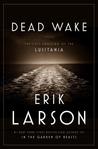 Dead Wake: The Last Crossing of the Lusitania by Erik Larson
My rating: 4 of 5 stars
This gripping non-fiction account of the final voyage of the Lusitania delves deeply into the personal history of key figures who played a role in one of modern history’s most notorious slaughters. The president of the United States, the captain of the eponymous ship, the captain of the U-boat, and many famous and wealthy passengers, some who lived and some who didn’t, are chronicled as a lead-in to the harrowing and detailed description of the sinking as described by English, Germans, Americans, crew, passengers, and British Admiralty. The crisp no-nonsense prose will appeal to readers and history buffs alike. My only complaint, and it is a very minor one, is that there is a bit too much filler. There is more biography of minor parties than necessary and the years of intrigue and naval warfare subsequent to the sinking that is described is equally unnecessary. Even so, I rushed to the end and the book in any event is not particularly long. Its acknowledgments and sources listed at the end are unusually extensive and thoroughly documented. Although a best-seller, it is a scholarly work worthy of a historian’s respect.
Before you start to flame me, call me racist, remove me from your friends or whatever, note that this post is meant to bring attention to how affirmative action hurts African-Americans and other minorities and works against bringing diversity to the workplace. You probably thought I was about to complain that affirmative action discriminates against whites. It does, of course, and I’ll get to that in a bit, but first consider this true story.
When I was in law school in the 70s I was the research assistant to a professor. This was Boalt Hall of Law, the law school at the University of California, Berkeley, probably the most liberal, even radical, law school in the country. The professor, a white male, was by any measure very liberal politically and a big believer in affirmative action. We became close friends and he eventually confided to me about his experience with affirmative action. He told me that he served on the admissions committee during the late sixties and early 70s, a time of protests about alleged racist admissions policies and perceived racism in general. There was great pressure from within the faculty and without to increase minority representation among the new students. In fact, there was no opposition to the idea from any quarter; the only problem was that Boalt was (and still is) one of the top law schools in the country and had very high admissions standards in terms of grades and Law School Admissions Test (LSAT) scores. Few of the underrepresented minorities (mostly blacks and Chicanos but to some extent women, too) applicants met the normal minimum standards. The committee decided to “lower the standards” (as some saw it) and count such things as community involvement, life experience, recommendations (especially from professors or others recognized as “activists”) and so on in order to increase the number of minorities admitted. This worked as expected; minority representation increased rapidly. Regrettably, some white male candidates with better grades and test scores who otherwise would have been admitted did not make it, but there are always well-qualified candidates who get passed over. C’est la vie. The students admitted under this new policy were referred to as “special admittances.”
Two years or so go by and the faculty is met with vehement protests by a coalition of those same students over the racist grading policies. It seems the special admittances were getting lower grades than the other students, getting mostly C’s and D’s. The ABCDF system was changed to HH (High Honors for the top 10%), H (Honors for the next 30%), P (Pass – for the rest who passed) and NP for those very few who didn’t pass. That way you couldn’t tell someone in the bottom 10% from someone just above 50th percentile. That didn’t help much and the protests continued. The students accused the faculty of being racists and grading them down because of their race. They demanded the grading system be changed again so that the tests (all essay types) had only a number instead of a name at the top. After the tests were graded, a staff member would match up the grades with the students using a secret list that the faculty couldn’t see. The faculty agreed to this. It seemed fair. Perhaps you can guess the outcome. Once this method was put in place, the special admittances’ grades plummeted. Many of them who had been scraping by were flunked. Virtually all of them saw their grades go down. After that they meekly agreed to go back to the previous grading system and protests stopped.
This story is not unique. It happens at schools and in companies all over America every day. Several lessons can be taken from it. First, it shows that a substantial number of minorities see racial discrimination against them where there is none or in fact is in their favor. Of course there were minorities who were admitted based on the usual standards, with high grades and test scores; not all were part of the special admittance group. I don’t know the exact percentages, but the special admittances were probably around half the African-American and Hispanic students. Second, a black or Latino student graduating from school X with a B average is probably not as good a student, not as smart or hard-working, as a white male from school X with a B average. Of course that minority student might be just as smart, hard-working and competent as the white student, but because of affirmative action and the special treatment in grades given minorities by liberal faculties, chances are good the graduate is second-rate compared to the white student. Employers know this, although you’ll probably never find one who will admit it. Political correctness rules the day in corporate America, too.
No doubt you’ve seen news stories or read blogs or articles about racism in hiring where two identical resumes were sent to employers differing only in having the applicant’s name on one being an apparent African-American name (e.g. Dante) and the other white-sounding (e.g. Donald). Inevitably Donald gets more positive responses than Dante, Tiffany more than Kaneesha, etc. If you are of a particular political persuasion you will attribute this to racism. No doubt that you would be right in some cases. I’m not denying that racism exists. But the more likely explanation for most of that phenomenon is affirmative action. Employers know that Dante probably really isn’t as good as Donald. Chances are substantial that he was admitted with lower test scores and his grades are inflated by well-meaning professors who probably aren’t even aware that they are favoring minorities in their grading. If I were hiring someone I would call Donald or Tiffany first even though I would prefer to hire a minority given two equal candidates since I believe society is healthier with a diverse workplace and upward mobility for all. I just wouldn’t believe the two candidates were really equal, at least not based on the resumes alone. Ideally I would interview both. This problem is exactly what Supreme Court Justice Clarence Thomas, an African-American, complained about in his memoir My Grandfather’s Son. He opposes affirmative action because he felt it kept him from advancing in his legal career precisely because law firms and other employers would not believe he could be as good as his grades and degree would indicate.
There’s another reason for employers to discriminate against minorities: they sue at a higher rate than whites and women sue at higher rates than men. At least that was my experience when I was an attorney for a government agency. Remember what I said about the students at Boalt. They were absolutely convinced that the faculty was grading them down because of their race when in fact they were being graded up. A minority female bus driver filed a civil rights lawsuit because she was not promoted to manager even though she was in the bottom 1% of all bus drivers in terms of performance and complaints from the public and well below the cutoff on the written test (which was graded blind by an outside firm that did not know the race of the applicants). She was convinced it was because of her race. A minority female filed a civil rights suit when she didn’t get a promotion to a senior planner position. A white male got that particular position. There were ten applicants including two males of her race. The interviewing committee narrowed it down to one of those males and the white male who finally got it. Both were much more qualified than she was. I got her suit dismissed on motions. For evidence she entered an affidavit from a black male who did not get the position of Accounting Supervisor at the agency even though the person who held it before leaving was a black female and before that a Filipino male. That was her “proof” that minorities are discriminated against in promotions. The special status given racial minorities in the legal process is akin to affirmative action. A large employer may be well-advised to hire qualified minorities in order not to show a pattern of discrimination in a lawsuit, but for a small employer where statistics do not work to show a pattern, they are actually better off not hiring a minority even if that minority is equally well-qualified as a white, simply because the chances of a lawsuit are lower. This is an ugly truth few will admit, but those tests using the two identical resumes proves that it is practiced.
What about the white males who do not get admitted or do not get hired or promoted? In fact, they are being discriminated against quite openly and it is unfair. I had an employer who was routinely told that she needed to hire more minorities or she would be fired. She advertised in minority-geared professional publications and did all kinds of outreach for months but got only one candidate; he was terrible – bad writing skills and with a spotty employment record. She hired me, a white male, and told me later she got terrible flak for it. So she hired a black female secretary who was the least competent employee I’ve ever seen. When I retired I left a file in her in box to be filed. I was called back weeks later when no one could find it and it was needed to settle a case. I came in and searched my old office and the files with no luck. I told the General Counsel that I had left it in the secretary’s in box for filing. The secretary insisted she had searched her desk top to bottom and it wasn’t there. She said she didn’t remember it and I must have been mistaken. It was finally located six months later at the bottom of the pile of papers in her in box right where I had left it. It was found only because the secretary had resigned to take a better-paying job. Fortunately, when she was fired from that job after 60 days, my old boss didn’t have to take her back because that position had already been filled. But the key here is that the General Counsel had been told in flat out terms that she had been hiring too many white males and if she fired that secretary, the only minority in the unit, she would be fired. After I left she was able to hire two minority female attorneys (an Asian and an Arab) and get the management off her back. The only thing that mattered to the upper management was diversity stats, not competence. At a previous job I was told by a manager that I was the best qualified candidate for a promotion but that they had to give it to a minority because they didn’t have any minority supervisors. This was said without the least fear that I would sue for racial discrimination even though that’s clearly what it was. Can you imagine a manager saying the same thing to a minority or female who was rejected based on race or sex? I was an EEO investigator in the FBI and investigated quite a few cases of alleged discrimination based on race, sex, or age. Only one was filed by a white male and he was clearly nuts (another politically incorrect term) as well as incompetent. White males just don’t sue, but don’t tell me we’re not discriminated against on account of race or sex.
It is this political correctness in favor of affirmative action and its near relatives in racial quotas at work that foments resentment among whites and males and ultimately does not benefit the very people it is intended to help. It is like spoiling your children. So you may ask (or complain) about why certain minorities don’t have the grades or test scores of whites or other minorities (e.g. Asians)? Is it a history of discrimination? Maybe Genetics? (See The Bell Curve). Could it be that they are raised by parents with lower education in depressed neighborhoods? Because a disproportionate number have parents with substance abuse problems? Attend K-12 schools that are underfunded or otherwise second-rate? This highly-charged question cannot be answered. People will believe what they want to believe. I don’t know and I don’t think it matters much. I believe that by the time he or she enters kindergarten, the maximum intellectual potential of an individual has pretty much been set, whether due to genetics, parenting, neighborhood, nutrition (or malnutrition), or a combination of everything. Why are there so few white running backs and wide receivers in the NFL? Racial discrimination? We are what we are. We should just accept it and judge everyone, at least for school admittance, hiring and promotion, on measurable objective criteria, even if it decreases diversity in race or sex. Affirmative action hurts everyone and helps no one. Those slots are essentially wasted since employers will assume the worst of every minority that comes out of that school, including the ones admitted based on merit alone, and it discriminates against white or Asian applicants. Employers who hire less-qualified minorities solely to meet affirmative action or diversity goals will just be less efficient and therefore less competitive.
Okay, now you can go ahead and flame me.
Microsoft deletes ‘teen girl’ AI after it became a Hitler-loving sex robot = Female bot goes loco at once; the girlie is evil extremist firebrand tart.
Original article:

Recently a close friend mentioned to me that he thought the most recent batch of Oreo cookies was sub-par, referring specifically to taste. My wife agrees. I haven’t noticed the taste being worse, but I have noticed that the cookies now arrive more broken up and often the two cookies separate, leaving frosting on only one. Based on this admittedly small data set, it seems that either Nabisco has cheapened the product or has QC issues at one of its bakeries.
This reminded me that I read somewhere recently that the Hydrox cookie is supposed to be coming back. I always preferred Hydrox to Oreos and was sad to see them go. Some people perceived Hydrox as knockoffs of Oreos, but actually the reverse is true. Hydrox came first and were such a big hit that Nabisco copied Sunshine with the Oreo, but used lard in their Oreo recipe, whereas Sunshine did not in the Hydrox. I read an article that described the vicious marketing war that Nabisco won – paying grocery store chains large sums to reduce shelf space of the Hydrox and reserve eye-level shelves for Oreos, among other things. It worked, eventually driving Hydrox off the market. That same article said that in blind taste tests Hydrox regularly beat Oreos, with 70% preferring Hydrox. I can believe it.
Wikipedia says that a company called Leaf is now making the Hydrox and that it should be available in most chains. I don’t do the grocery shopping, so I wouldn’t know, but can anyone verify that? I’ll let my wife know to be on the lookout.
From the Washington Post:
Hell might actually be other people — at least if you’re really smart.
That’s the implication of fascinating new research published last month in the British Journal of Psychology. Evolutionary psychologists Satoshi Kanazawa of the London School of Economics and Norman Li of Singapore Management University dig in to the question of what makes a life well-lived. While traditionally the domain of priests, philosophers and novelists, in recent years survey researchers, economists, biologists and scientists have been tackling that question.
Read the rest of the article here.
